01 — Primer入門
Two bodies are a clock. Three are weather. 兩顆是鐘,三顆是天氣。
The three-body problem asks a sentence a child can repeat and a civilization cannot finish: given three masses, Newton’s inverse-square gravity, and initial positions and velocities — where are they later? 三體問題是一句小孩會複述、文明卻寫不完的句子:三顆有質量的物體,服從牛頓平方反比引力,給定初始位置與速度——之後它們在哪?
Start with one.先從一顆開始。
A single mass in empty space goes in a straight line at constant speed. That is Newton’s first law, and it is already a solution: the universe with nothing to pull on you is boring, and exactly solvable. 空無一物的空間裡,一顆質量沿直線等速前進。這是牛頓第一定律,也已經是一個解:沒有人拉你的宇宙很無聊,而且精確可解。
Two: the closed-form universe.兩顆:寫得下來的宇宙。
Add a second mass and something kind happens. The pair can be replaced by one fictitious “reduced mass” orbiting a fixed center of mass. Newton, with Kepler’s three laws as clues, showed that the orbit is a conic section: ellipse, parabola, or hyperbola. Energy and angular momentum lock the shape. Earth around the Sun is this story, to an excellent first approximation — a clock with a very slow error. 加上第二顆,事情變得溫和。這一對可以換成一顆虛構的「約化質量」,繞著質心轉。牛頓藉克卜勒三定律指出:軌道是圓錐曲線——橢圓、拋物線或雙曲線。能量與角動量把形狀鎖死。地球繞日,在極好的第一近似下就是這個故事:一座誤差很慢的鐘。
In the lab above, choose Two-body Kepler. The trail closes. Tomorrow resembles yesterday. Calendars are possible. 在上面的實驗室選「二體克卜勒」。軌跡會閉合。明天像昨天。日曆成為可能。
Three: the integrals run out.三顆:積分用完了。
Eighteen numbers describe three particles in space (three positions and three velocities each). Conservation laws — energy, linear momentum, angular momentum, and the freedom to pick the center of mass — give ten integrals. You would need more to reduce the system to quadratures, the way the two-body problem reduces. They are not there. In 1887–1890, Poincaré, competing for King Oscar II’s prize, showed that the three-body problem is not integrable in the classical sense: its trajectories can weave densely, and a power series for the motion need not converge in a useful way. Chaos, in the modern sense, is born in that memoir. 三顆粒子在空間裡要用十八個數字來描述(各三個位置、三個速度)。守恆律——能量、動量、角動量,加上選質心的自由——給出十個積分。若想像二體那樣化成求積,你還需要更多。它們不存在。1887–1890,龐加萊為奧斯卡二世國王的懸賞寫作時指出:三體問題在古典意義上不可積,軌跡可以稠密地編織,冪級數也不會以有用的方式收斂。現代意義的「混沌」,誕生在那份備忘錄裡。
Not “uncomputable for a minute.” Unpredictable as a climate. 不是「一分鐘算不出來」,而是像氣候一樣無法長期預報。
Turn on Chaos twin in the lab. A ghost copy of the same system is given a velocity error of about \(10^{-6}\). On the figure-8 they linger together. On Chaotic scatter or Trisolaris, the distance between twins grows until they are different stories. That exponential parting is measured by a Lyapunov exponent; its inverse is a Lyapunov time — how long a forecast remains meaningful. 在實驗室打開「混沌雙生」。同一系統的幽靈複本被加上約 \(10^{-6}\) 的速度誤差。在 8 字解上它們會長時間挨在一起;在「混沌散射」或「三體世界」裡,雙生距離會一直長大,直到變成兩個故事。這指數分離由李亞普諾夫指數衡量,它的倒數是李亞普諾夫時間——預報還有意義的時限。
Exceptions: islands in the sea.例外:海上的島。
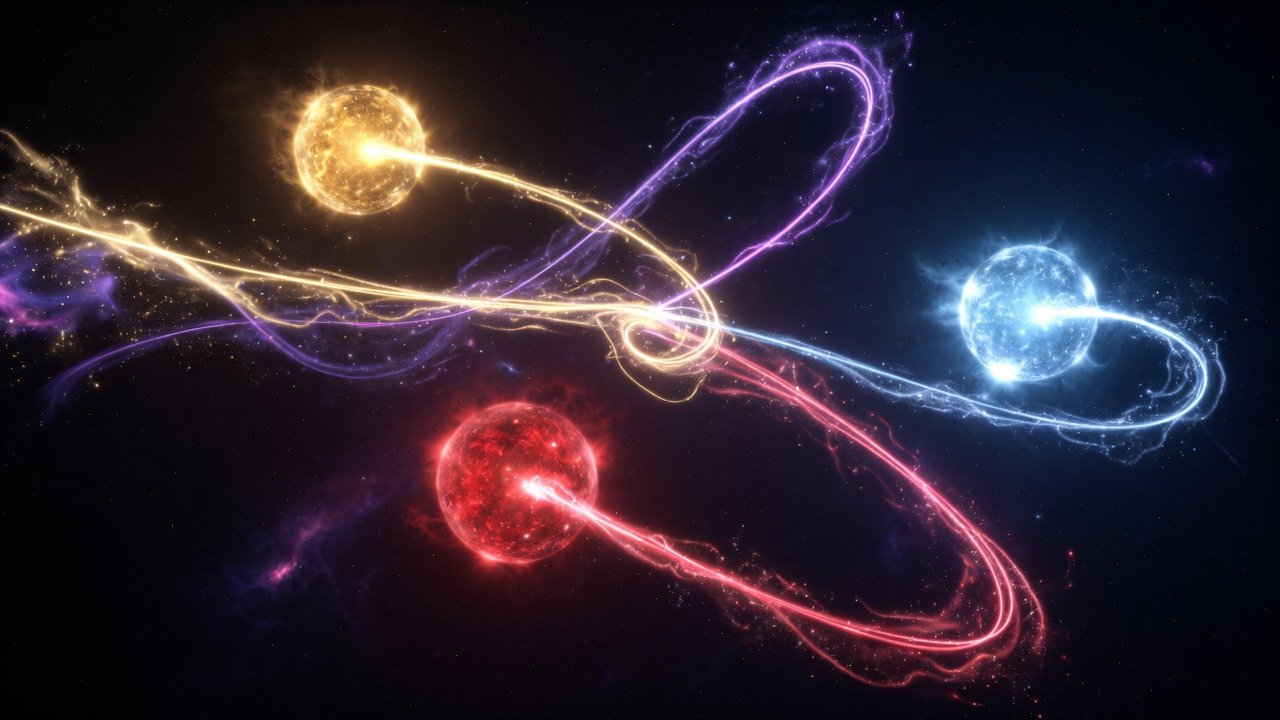
“No general closed-form solution” is not “no solutions.” Euler found collinear particular solutions; Lagrange found the equilateral ones (1772). In 1993 Cris Moore discovered a figure-8 choreography, later proved by Chenciner and Montgomery: three equal masses chase one another around a single eight-shaped curve. Simó showed it is remarkably stable for a three-degree-of-freedom Hamiltonian system. Thousands of other periodic dances have since been catalogued. They are islands. The ocean is still chaos. 「沒有一般的閉式解」並不是「沒有解」。歐拉找到共線特解;拉格朗日找到正三角形解(1772)。1993 年 Cris Moore 發現 8 字編舞,後由 Chenciner 與 Montgomery 證明:三顆等質量天體在同一條 8 字曲線上互相追逐。Simó 指出,對一個三自由度哈密頓系統而言,它異常穩定。此後人們編目了成千上萬種週期之舞。它們是島。海,仍是混沌。
A more useful loophole is hierarchy: a tight pair plus a distant third. Then you can pretend, for a while, that you have two two-body problems stacked. Most real triples in the sky survive this way. Try Hierarchical triple, then Nudge. 更有用的漏洞是階層:一對緊密雙星,加上遠處第三者。一時之間,你可以假裝那是兩個疊起來的二體問題。天上大多數能活下來的三星都是這樣。試試「階層三體」,再按「輕推」。
02 — Daily life日常生活
You already live inside approximations of three bodies. 你早已住在三體的近似裡。
Nobody solves the general three-body problem to catch a bus. But the special cases — especially the restricted problem, where one mass is a speck — are built into tides, timekeeping, navigation, and the parking orbits of telescopes. 沒有人為了趕公車去解一般三體問題。可那些特例——尤其是一顆質量輕得像塵埃的限制性三體——已經織進潮汐、計時、導航,以及望遠鏡的停泊軌道。
Tides, calendars, leap of the sea潮汐、日曆、海的起落
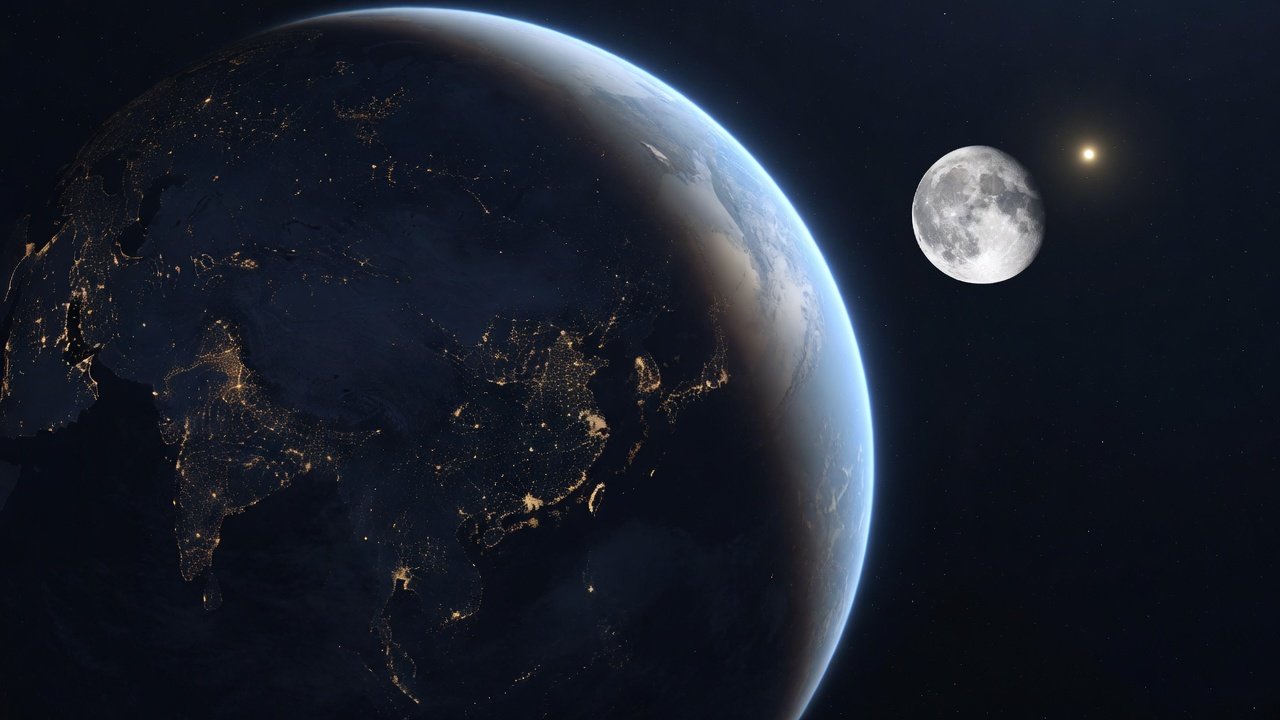
The Earth–Moon pair is a two-body clock. The Sun makes it three. When Sun and Moon pull along one line, tides spring; when they pull at right angles, tides neap. Eclipse seasons exist because three bodies must line up in a plane that itself slowly nods. You do not need chaos for this — you need perturbations. The third body is a correction that your ancestors already named: spring, neap, syzygy. 地月是一座二體鐘。太陽把它變成三體。日月拉力共線時是大潮,互相垂直時是小潮。日食季存在,是因為三顆物體必須在一個本身會慢慢點頭的平面裡排成一線。這裡還不必請出混沌——只要攝動。第三顆是你祖先已經命名的修正:大潮、小潮、朔望。
GPS, BeiDou, a moon in the error termGPS、北斗,誤差項裡的月亮
A navigation satellite is almost in Keplerian orbit around Earth. “Almost” is the job. Lunar gravity, solar gravity, Earth’s oblateness, radiation pressure — each is a perturbation. Precise ephemerides integrate an N-body model; without the Moon and Sun in the force function, your phone’s meter-level fix would wander. The three-body problem, here, is not a metaphor. It is a line of code in the orbit determination filter. 導航衛星幾乎在地球的克卜勒軌道上。「幾乎」才是工作。月球引力、太陽引力、地球扁率、輻射壓——都是攝動。精密星曆積分的是 N 體模型;力函數裡若沒有日月,手機的米級定位會漂。這裡的三體問題不是比喻,是定軌濾波器裡的一行程式。
Lagrange points: parking without a road拉格朗日點:沒有路的停車場
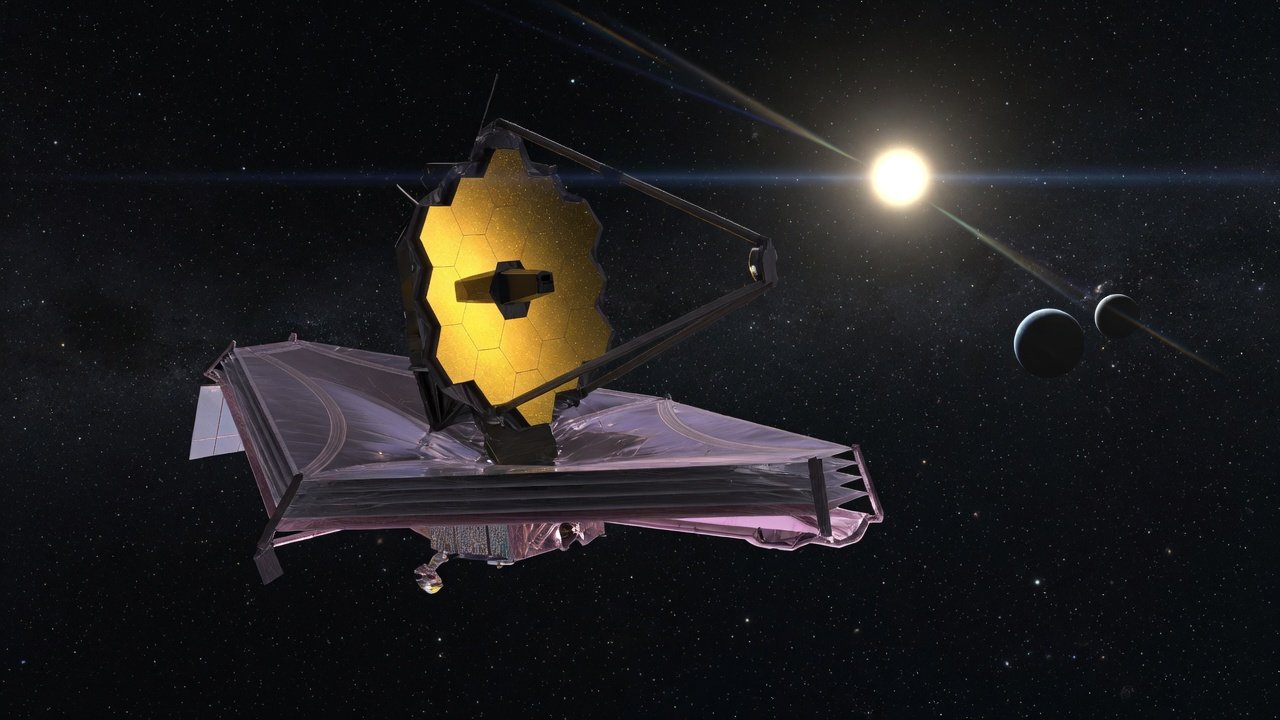
In the circular restricted three-body problem, two heavy bodies orbit their common center, and a third of negligible mass moves in their potential. In the rotating frame there are five equilibrium points L1–L5. L4 and L5 form equilateral triangles; they can be stable (Trojan asteroids live there around Jupiter). L1, L2, L3 sit on the line of the two heavies and are unstable — yet a spacecraft can hover nearby on a halo or Lissajous orbit with modest station-keeping fuel. 在圓型限制性三體問題裡,兩顆重物體繞公共質心轉,第三顆可忽略質量在它們的勢中運動。旋轉座標系中有五個平衡點 L1–L5。L4、L5 構成正三角形,可以穩定(木星的特洛伊小行星住在那裡)。L1、L2、L3 在兩顆重物體的連線上,不穩定——但航天器仍能以少量維持燃料,在附近的暈軌道或 Lissajous 軌道上盤旋。
- Sun–Earth L1 — SOHO, DSCOVR: a continuous stare at the Sun and at Earth’s dayside, up-sun of us. 日–地 L1 — SOHO、DSCOVR:在我們的上日側,持續凝視太陽與地球白晝面。
- Sun–Earth L2 — Planck, Gaia, and the James Webb Space Telescope. Earth, Moon, and Sun sit in a convenient pile behind the sunshield. Astronomy as a three-body parking trick. 日–地 L2 — Planck、Gaia、詹姆斯·韋伯太空望遠鏡。地球、月球與太陽被整齊地堆在遮光罩後方。天文學,是三體停車的技巧。
- Earth–Moon L2 — Queqiao (鵲橋, 2018) flew a halo orbit beyond the Moon so Chang’e-4 could land on the far side and still speak to Earth. Queqiao-2 later used a frozen elliptical lunar orbit for south-pole and far-side relays. The Magpie Bridge of the folk tale is, here, a solution of the restricted three-body problem. 地–月 L2 — 鵲橋號(2018)在月球外側的暈軌道上,讓嫦娥四號能在月背著陸仍與地球通話。鵲橋二號後來改用冷凍橢圓月球軌道,服務南極與月背中繼。民間故事裡的鵲橋,在這裡是限制性三體問題的一個解。
- Cislunar highways — The Interplanetary Transport Network uses stable and unstable manifolds of Lagrange points as low-energy on-ramps. Missions sip fuel by falling along the three-body flow instead of fighting it. 地月空間的公路 — 行星際運輸網絡把拉格朗日點的穩定/不穩定流形當成低能匝道。探測器沿著三體流下落,而不是與它搏鬥,從而省下燃料。
03 — In the universe在宇宙裡
Three is how the sky actually comes packaged. 天,本來就是三顆三顆來的。
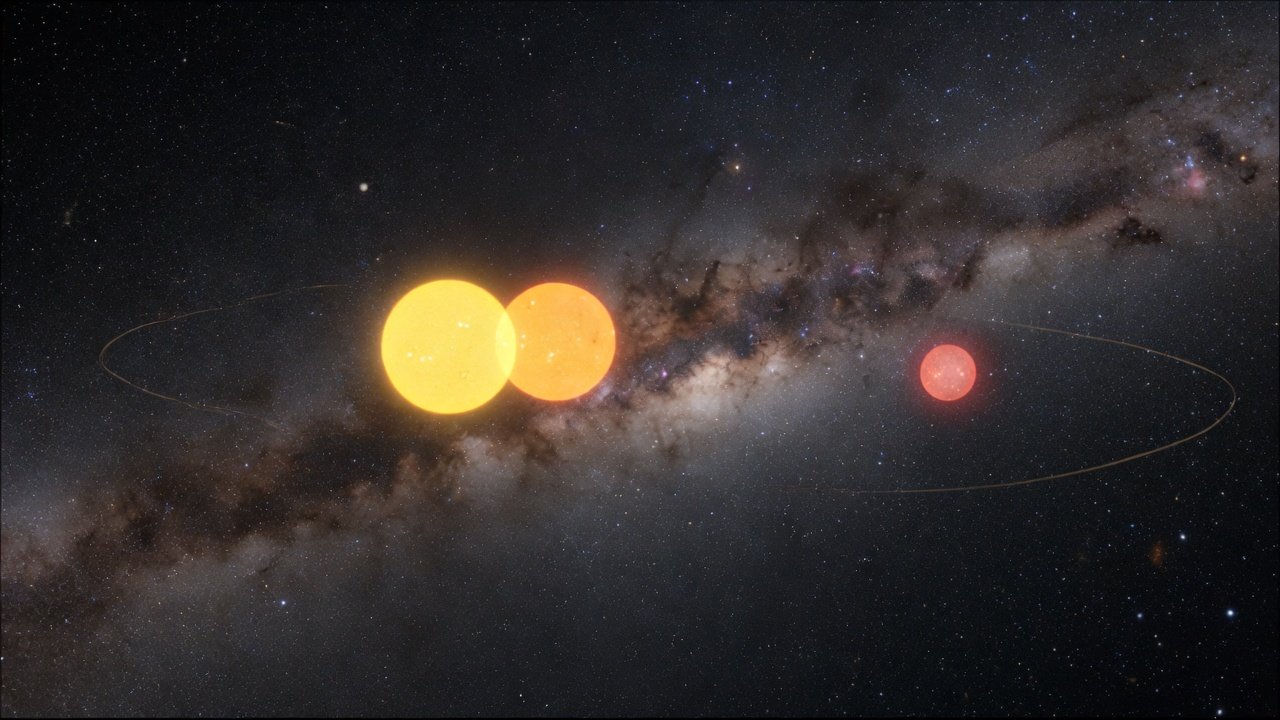
Isolated binaries are a textbook convenience. Massive stars are often born in triples and quadruples. Our nearest star system is already three: α Centauri A and B in an 80-year dance, Proxima a red dwarf bound on a much wider orbit. The universe prefers hierarchy, because non-hierarchical triples tend to fling a member out and leave a tighter binary — a three-body encounter with a receipt. 孤立雙星是教科書的方便假設。大質量恆星常常生在三合、四合系統裡。離我們最近的恆星系統已經是三顆:半人馬座 α 的 A 與 B 以約八十年共舞,比鄰星這顆紅矮星在寬得多的軌道上被綁住。宇宙偏愛階層,因為非階層三體會傾向甩出一員、留下更緊的雙星——一場附收據的三體遭遇。
Kozai–Lidov: the third body as a slow hand科扎伊–利多夫:第三者的慢手
Even a polite hierarchical triple is not two separate clocks. Averaged over many orbits, the outer body torques the inner orbit. Inclination and eccentricity trade places: a nearly circular inner path can be pumped to a needle-thin ellipse, then return. This Kozai–Lidov (von Zeipel) cycle shapes moons, exoplanets, and the pipelines that drive compact binaries to merge — including some of the black-hole collisions heard by LIGO. A third body, far away and seemingly irrelevant, can be the reason two others finally touch. 即使是禮貌的階層三體,也不是兩座互不相干的鐘。對許多軌道平均之後,外層天體對內層軌道施力矩。傾角與離心率彼此交換:近圓的內軌道可以被泵成針細的橢圓,再回來。這套科扎伊–利多夫(von Zeipel)循環塑造衛星、系外行星,以及把緻密雙星推向合併的管線——包括 LIGO 聽見的一部分黑洞碰撞。遠處、看似不相干的第三者,可以是另外兩顆終於相觸的原因。
Clusters, ejections, blue stragglers星團、逃逸、藍掉隊星
In a globular cluster the three-body problem is a contact sport. Binaries harden by scattering singles; stars are ejected at high speed; mergers make blue stragglers that look younger than they are. The Hills mechanism — a binary torn by a supermassive black hole — can fire a hypervelocity star out of a galaxy. These are not metaphors borrowed from Poincaré. They are Poincaré, at milliparsec range, with fusion. 在球狀星團裡,三體問題是接觸性運動。雙星靠散射單星而變硬;恆星被高速甩出;合併造出看起來比實際年輕的藍掉隊星。Hills 機制——超大質量黑洞撕開一對雙星——可以把超高速星射離星系。這不是從龐加萊借來的比喻。這就是毫秒差距尺度、帶著核融合的龐加萊。
The solar system is an N-body climate太陽系是 N 體氣候
Integrate the planets for ten million years and nearby initial conditions diverge. The inner solar system’s Lyapunov time is a few million years. That does not mean Earth leaves next Thursday; KAM islands and averaging keep the architecture intact far longer than the Lyapunov time. It does mean that a million-year forecast of Mercury’s exact longitude is a kind of fiction — weather, not a clock. Planetary architecture is statistically durable and individually forgetful. 把行星積分一千萬年,鄰近的初值會分道揚鑣。內太陽系的李亞普諾夫時間大約數百萬年。這不表示地球下星期四就會離家;KAM 島嶼與平均化讓結構比李亞普諾夫時間耐久得多。但這確實表示:對水星經度做百萬年預報是一種虛構——是天氣,不是鐘。行星架構在統計上耐久,在個體上健忘。
Zoom out once more and a galaxy is \(10^{11}\) bodies. Nobody integrates them as a literal N-body problem for every star; we use trees, particles on meshes, distribution functions. The three-body problem remains the local verb: capture, eject, merge, exchange. Every wide binary, every runaway O star, every planet tossed into the dark is a sentence conjugated from three masses. 再往外一層,星系是 \(10^{11}\) 顆物體。沒有人對每顆星做字面 N 體積分;我們用樹碼、網格上的粒子、分布函數。三體問題仍是那個地方性的動詞:捕獲、甩出、合併、交換。每一對寬雙星、每一顆逃逸 O 型星、每一顆被拋進黑暗的行星,都是由三個質量變位而來的句子。
04 — The novel小說
《三體》: when a theorem becomes a climate, then a war. 《三體》:當一條定理變成氣候,再變成戰爭。
Mild spoilers for Book I of Remembrance of Earth’s Past. 含《地球往事》第一部《三體》的輕度劇情。
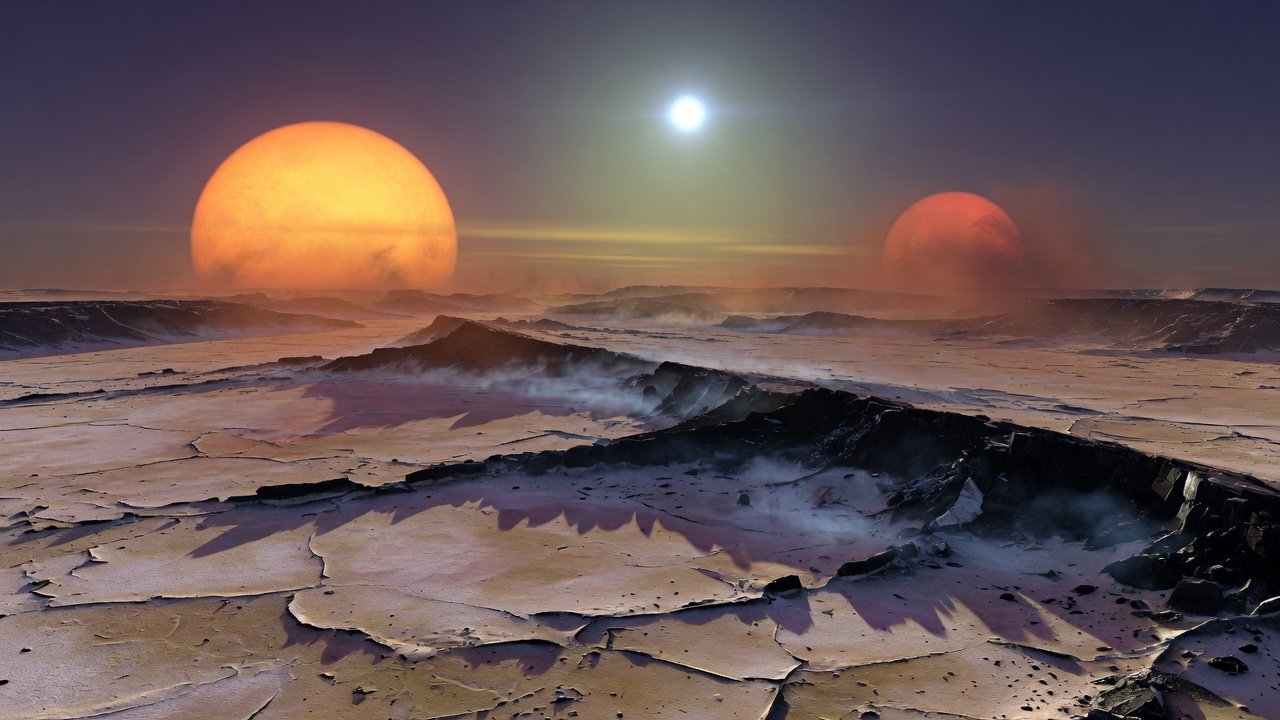
Liu Cixin’s 《三體》 (first serialized 2006, book 2008; Ken Liu’s English translation won the Hugo Award in 2015) takes the least visual theorem in classical mechanics and makes it a planet’s weather, then a species’ foreign policy. Trisolaris is imagined as a world in a three-star system identified with α Centauri. Because the three suns cannot be forecast, the planet alternates between Stable Eras and Chaotic Eras. Civilizations dehydrate, wait, rehydrate; they rise and are burnt away, hundreds of times. The only strategic exit is a star that behaves like a clock: the Sun. 劉慈欣的《三體》(2006 年連載,2008 年出版;劉宇昆英譯於 2015 年獲雨果獎)把經典力學裡最不具象的一條定理,做成一顆行星的天氣,再做成一個物種的外交。三體世界被設想為半人馬座 α 那樣的三星系統中的行星。三顆太陽無法預報,行星便在恆紀元與亂紀元之間切換。文明脫水、等待、再水化;興起,被燒成灰,數百次。唯一的戰略出口,是一顆像鐘一樣走路的恆星:太陽。
On the page紙上
Three comparable suns, close enough that a planet feels all of them as weather. Eras of freezing and eras of boiling. A video game that is secretly a physics sandbox and a historical record. Sophons: protons unfolded in extra dimensions, used as supercomputers and as a lock on Earth’s particle physics. The three-body problem is not a chapter of exposition. It is the antagonist’s childhood. 三顆質量相當的太陽,近到一顆行星會把它們全部當成天氣。凍結的紀元,沸騰的紀元。一款其實是物理沙盒與史書的遊戲。智子:在高維展開的質子,既是超級電腦,也是鎖死地球粒子物理的鎖。三體問題不是一段說明文,是敵方的童年。
In the sky天上
α Centauri is hierarchical: A and B (roughly 1.1 and 0.9 solar masses) orbit in about 80 years between Saturn-like and Pluto-like separations; Proxima, a faint flare-prone red dwarf, sits thousands of astronomical units out on an orbit of hundreds of thousands of years. A planet around one of them does not see three suns whipping overhead on human timescales. Proxima b is real; it is not Trisolaris. A fully chaotic, equal-mass, compact triple with a habitable planet is dynamically rude: the planet is typically ejected or accreted long before cities. 半人馬座 α 是階層的:A 與 B(約 1.1 與 0.9 太陽質量)以約 80 年在土星到冥王星那樣的距離間互繞;比鄰星是會閃焰的暗淡紅矮星,在數千天文單位之外,軌道週期數十萬年。繞其中一顆的行星,不會在人類時間尺度上看到三顆太陽在頭頂抽打。比鄰星 b 是真的;它不是三體世界。一組完全混沌、等質量、緊湊、還帶宜居行星的三星,在動力學上很無禮:行星通常在城市出現之前就被甩出或吞沒。
Liu knows this well enough to make the game in the novel a numerical laboratory: players fail, as Poincaré failed, to find a useful closed form, and the failure is the pedagogy. The science that remains honest is not the postal address “α Centauri,” it is the emotional theorem: when the sky has no calendar, intelligence becomes a survival strategy of last resort, then of first strike. Sophons are fiction; chaotic sensitivity is not. The Dark Forest that follows in later books is sociology hung on that mechanical hook. 劉慈欣清楚得很,才讓小說裡的遊戲成為數值實驗室:玩家失敗,如同龐加萊失敗,找不到有用的閉式;失敗本身即是教學。仍然誠實的科學不是「半人馬座 α」這個郵政地址,而是那條情感定理:當天空沒有日曆,智力先成為最後的求生術,再成為先發制人。智子是虛構;混沌敏感不是。後續的黑暗森林,是掛在這根力學鉤子上的社會學。
The novel is allowed to lie about α Centauri. It is not lying about chaos. 小說可以對半人馬座 α 說謊。它沒有對混沌說謊。
Load the Trisolaris preset. Watch a green planet try to keep a home among three suns. Then load Hierarchical triple. The difference between those two runs is the difference between a fable and a neighbor. Both belong on this page. 載入「三體世界」預設。看一顆綠色行星如何在三顆太陽之間試圖安家。再載入「階層三體」。這兩次運算的差別,就是寓言與鄰居的差別。兩者都該留在這頁上。
05 — Deeper water深水
What “unsolvable” actually means. 「無解」究竟是什麼意思。
Poincaré did not prove that computers are useless. He proved that the three-body problem is not a cleverer two-body problem. The distinction still organizes celestial mechanics. 龐加萊並沒有證明電腦沒用。他證明三體問題不是一個更聰明的二體問題。這條分界至今仍組織著天體力學。
Dimension count數維度
Phase space for three point masses in \(\mathbb{R}^3\) is 18-dimensional. Translation invariance and conservation of linear momentum remove 6; rotation invariance and angular momentum remove 3 more in the reduction (with care at vanishing angular momentum); energy is one more. What remains is still too large, and the remaining vector field does not admit additional analytic integrals of the kind that would finish the reduction. Bruns (1887) and Poincaré: no further algebraic integrals in the momenta. The system is non-integrable. Trajectories may still be continued numerically until a collision, and collisions themselves can often be regularized (Levi-Civita, Kustaanheimo–Stiefel). 三個質點在 \(\mathbb{R}^3\) 的相空間是 18 維。平移不變與動量守恆去掉 6 維;旋轉不變與角動量在約化中再去掉 3 維(角動量為零時要小心);能量再一維。剩下的仍然太大,而且剩餘的向量場不再承認能把約化做完的那類解析積分。Bruns(1887)與龐加萊:動量中沒有更多代數積分。系統不可積。軌跡仍可數值延拓直到碰撞,而碰撞本身往往能被正則化(Levi-Civita、Kustaanheimo–Stiefel)。
Sundman’s series, and why nobody uses itSundman 級數,以及為何沒人用
In 1912 Karl Sundman produced a convergent power series for the three-body problem (assuming non-zero angular momentum). It is a solution in the strict sense, and a practical joke: the number of terms needed for modest accuracy is astronomical. Existence is not a forecast. Modern work lives in numerics (symplectic leapfrog, Wisdom–Holman maps for hierarchical systems, IAS15 and other high-order integrators) and in geometry (KAM tori, Aubry–Mather theory, weak stability boundaries, contact topology of the restricted problem). 1912 年 Karl Sundman 為三體問題寫出收斂冪級數(假設角動量不為零)。嚴格意義上這是解,也是一個實用玩笑:要達到普通精度,所需項數是天文數字。存在不是預報。現代工作住在數值裡(辛 leapfrog、階層系統的 Wisdom–Holman 映射、IAS15 等更高階積分器),也住在幾何裡(KAM 環面、Aubry–Mather、弱穩定邊界、限制性問題的接觸拓撲)。
The lab on this page uses a fixed-step RK4 integrator in units where \(G=1\), with a small softening length so close encounters do not detonate the timestep. Watch \(\Delta E/E\): on the figure-8 it should stay tiny; in a merger it will jump because the model changed. The twin separation is a toy Lyapunov indicator, not a publishable exponent. For real mission design one uses regularized, adaptive, often relativistic codes and a force model that includes more than three bodies. The qualitative lesson survives the upgrade. 本頁實驗室使用定步長 RK4,單位 \(G=1\),並加微小軟化長度以免近距離交會炸掉時間步。看 \(\Delta E/E\):在 8 字解上應保持極小;合併時會跳變,因為模型已經換了。雙生距離是玩具式的李亞普諾夫指標,不是可發表的指數。真正的任務設計要用正則化、自適應、往往還含相對論的程式,力模型也不止三體。定性的功課,升級之後仍在。
06 — Sources來源
If you want the papers behind the sky. 若你想要天空背後的論文。
Poincaré, Les méthodes nouvelles de la mécanique céleste (1892–99). Lagrange, Essai sur le problème des trois corps (1772). Moore, “Braids in classical gravity,” Phys. Rev. Lett. 70 (1993). Chenciner & Montgomery, “A remarkable periodic solution…,” Ann. of Math. (2000). Montgomery, “A new solution to the three-body problem,” Notices AMS (2001). Sundman, Acta Math. (1912). NASA, “What is a Lagrange point?” Queqiao / CNSA Chang’e-4 relay (2018). Liu Cixin, 《三體》; Ken Liu tr., The Three-Body Problem (2014).